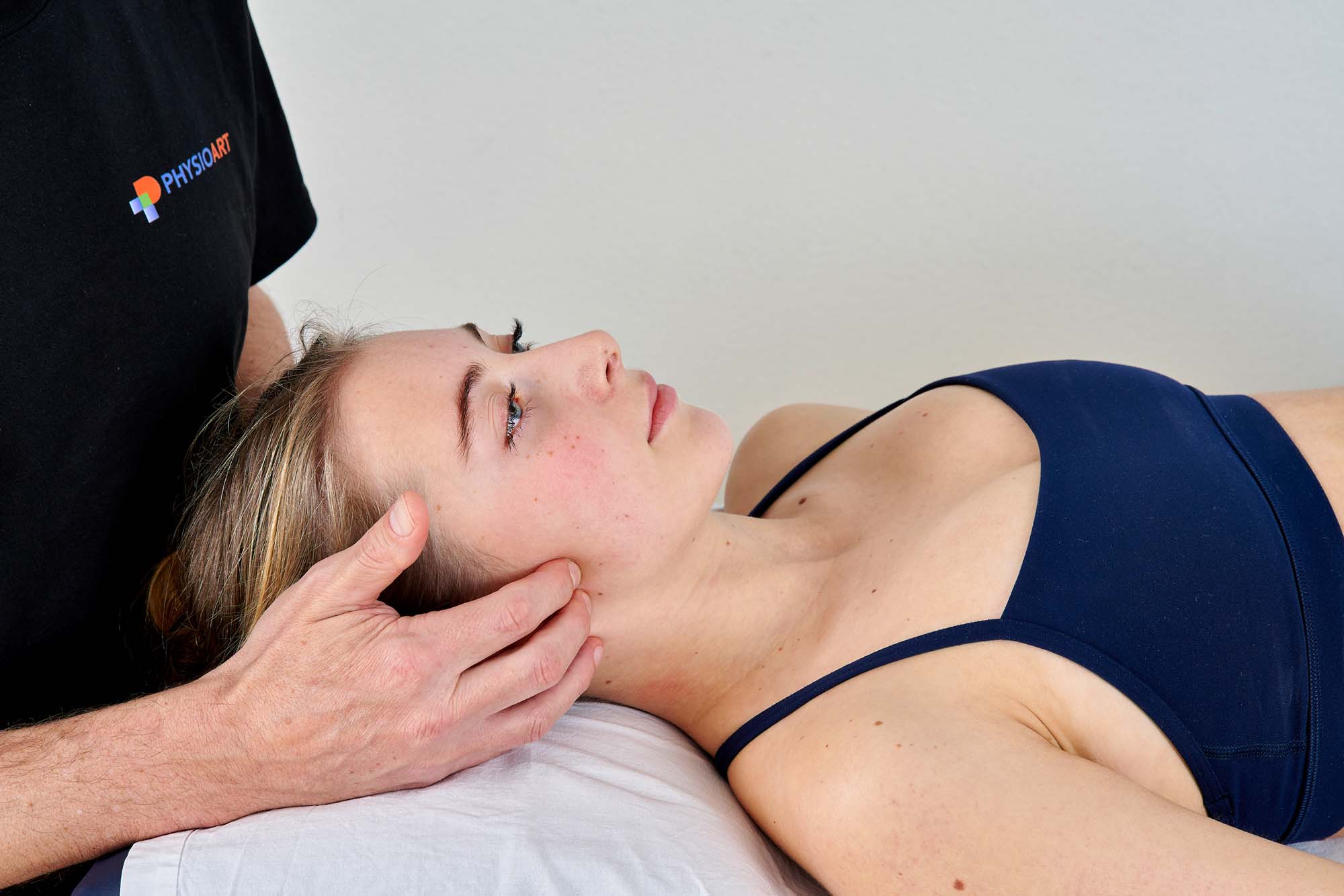


Disc herniation: What physiotherapy can really achieve
The diagnosis of „herniated disc“ immediately triggers in many people the thought of surgery. Understandably, because the term sounds threatening. In fact, however, the vast majority of herniated disc cases do not require surgery and can be treated effectively with targeted physical therapy.
Anyone who understands how a herniated disc occurs and when treatment is appropriate can assess their own situation more realistically, rather than letting the diagnosis alone cause them to become anxious.
What is a Disc herniation?
The discs lie between the vertebrae and act as shock absorbers for the spine. Each disc consists of a softer core (Nucleus pulposus) surrounded by a firmer fibrous ring (Anulus fibrosus). If the outer fibrous ring tears, tissue from the core can protrude outwards and press on a nerve root or the spinal canal. This is referred to as a disc prolapse or disc herniation. If the disc bulges forward while the outer fibrous ring remains intact, it is called a protrusion. Both can cause symptoms, but are often also unnoticed.
How a herniated disc occurs
A herniated disc usually develops over a long period of time, even though the symptoms often appear suddenly. The causes are multifactorial. Contributing factors are:
- Age-related changes in the discs of the spine, which cause them to lose elasticity
- Unilateral stress in everyday life or at work over many years
- General lack of movement and weakened trunk muscles
- Genetically determined differences in the resistance of connective tissue
A herniated disc can also occur in young, athletic people!
Typical symptoms
Affected people usually report:
- Back pain that intensifies or diminishes depending on body position
- Pain radiating to the leg or, in the case of an incident in the neck region, to the arm
- Numbness or tingling along the affected nerve
- Loss of strength in the affected muscle
- A protective muscle tension in response to the pain
Does a herniated disc need to be operated on?
In most cases, surgery is not necessary. Studies and treatment guidelines show that a large proportion of herniated disc cases improve significantly with conservative, i.e., non-surgical, treatment. Often, the herniated tissue regresses over time. Physiotherapy plays a central role in this process. Surgery is usually only considered if no improvement occurs despite consistent conservative treatment or if certain warning signs are present (see below: «when surgery is necessary»).
How a herniated disc is treated physiotherapeutically
The investigation structures the individual situation:
- History: Pain course, triggers and previous diagnostics, such as an existing MRI
- Neurological examination: Testing strength, reflexes, and sensitivity to assess the extent of nerve involvement
- Motion analysis and posture assessment: Classification of movements and positions that increase or alleviate the symptoms
- Cooperation with medical examination: In the case of an unclear finding or warning signs, a medical evaluation and, if necessary, imaging are included.
This examination forms the basis for a treatment program that is tailored to the individual’s actual ability to cope.
What is really helpful in the case of a herniated disc from a physiotherapeutic point of view
As the patient's tolerance changes during the healing process, the treatment gradually adapts. The following have proven effective:
- Pain-relieving storage and movement instructions in the acute phase, to relieve the affected nerve root
- Manual therapy to resolve accompanying tension and movement restrictions
- Targeted training therapy for building the trunk and back muscles as soon as the acute phase has subsided. More about this on our page on Training therapy in Basel.
- Posture training, To specifically relieve the spine in everyday life
- Step-by-step load buildup, to safely return to the usual activity
These measures are based on the actual patient's tolerance and are continuously adjusted during the healing process.
When an operation is necessary
Even though most cases of herniated discs are treated conservatively, there are situations in which rapid medical and, if necessary, surgical evaluation is necessary:
- New onset of paralysis or significantly increased weakness
- Numbness in the area between the legs or in the genital area
- New onset disorders of bladder or bowel function
- Unbearable pain that does not respond to conservative treatment
These warning signs are rare, but require immediate medical evaluation.
The most important findings in summary
- Most herniated disc cases do not require surgery and can be treated conservatively.
- Physiotherapy supports the healing process through pain-relieving measures, education, targeted home exercises, and load building.
- Certain warning signs require immediate medical evaluation.
- A structured examination shows which treatment is appropriate in the individual case.
Frequently asked questions about the herniated disc
No. The vast majority of herniated disc cases are successfully treated conservatively, that is, without surgery. Surgery is only considered in certain warning signs or if there is no improvement.
This varies greatly from person to person. Many affected individuals experience a significant improvement within a few weeks, but complete recovery of their resilience can take several months.
Moderate, pain-adapted exercise is usually recommended and supports the healing process. Which exercises are suitable in a given case should be determined individually.
A herniated disc is a possible cause of sciatica pain, but not the only one. Pain radiating along the sciatic nerve can also be caused by muscular tension. A targeted examination clarifies which cause is actually present.
In some of the affected individuals, the herniated disc tissue regrows on its own over time. Regardless of this, physiotherapy supports the healing process and helps to make the body more resilient through active exercise.
In case of new onset paralysis, numbness in the genital area, bladder or bowel problems, or unbearable pain, immediate medical evaluation should be sought.
At PhysioART Basel, we specifically examine your complaints and create a treatment program that is tailored to your individual tolerance level. You can find more information about our approach on our page about Physiotherapy in Basel.
Do you want to have your suspected herniated disc examined?
At PhysioART Basel, we specifically examine your complaints and create a treatment program that is tailored to your individual tolerance level. You can find more information about our approach on our page about physiotherapy in Basel.
Book an appointment now