

Recognised by health insurance companies:
Our treatments are recognised by all Swiss supplementary insurance companies. If required, we can draw up therapy reports to facilitate co-operation with your doctor and the procurement of prescriptions.

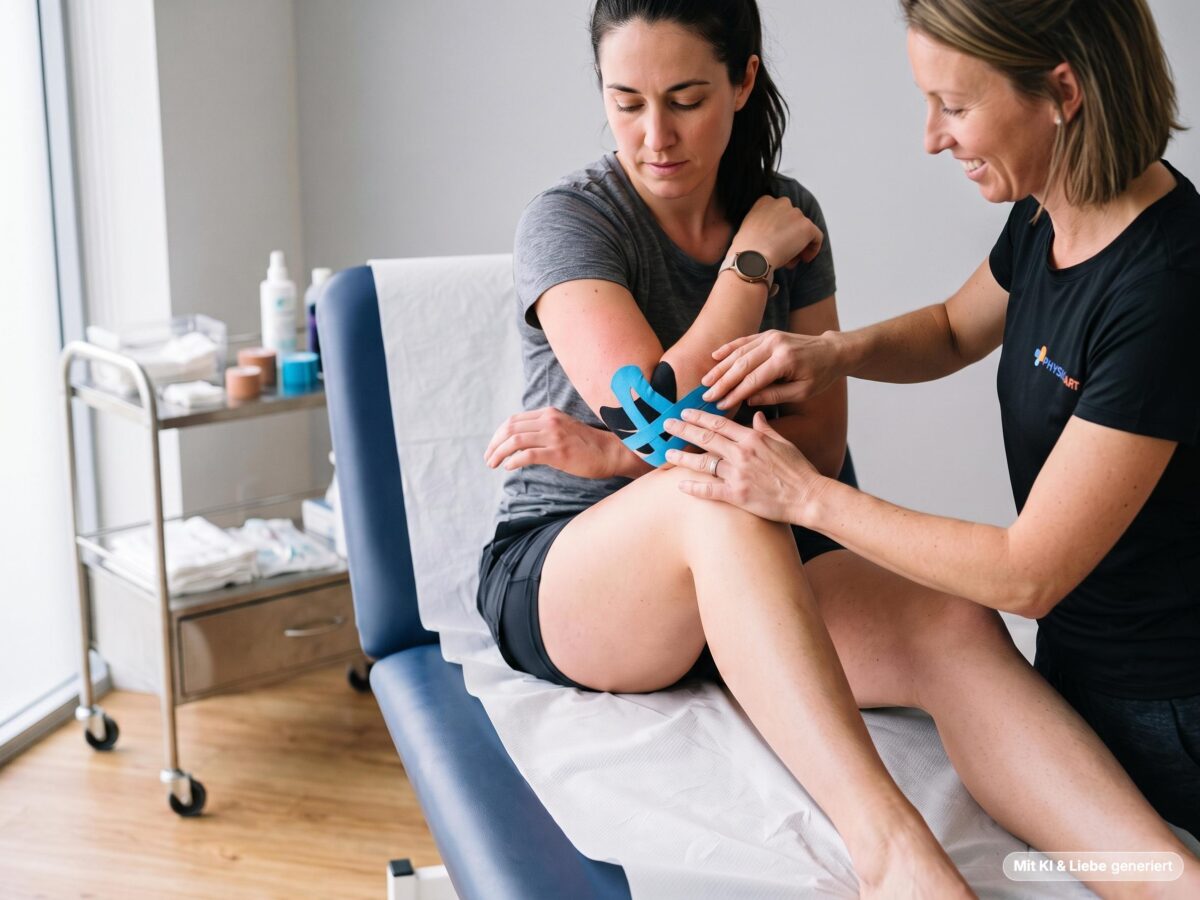
A pulling pain on the outside of the elbow that gets worse with every movement?
This could be a so-called Tennis elbow be - medically correctly referred to as Lateral epicondylitis.
In addition to physiotherapy, active exercises and targeted load management, the Kinesio taping has proven to be an effective supplement in treatment.
In this article, you will learn how a Taping lateral epicondylitis when this makes sense - and what else you can do.
A Tennis elbow, medical Lateral epicondylitis, occurs due to an overload of the tendon insertions of the forearm extensor muscles on the outer elbow bone. Despite the name, the complaint in most cases has nothing to do with tennis. Common triggers are:
The tendon attachments react to sustained overload with small micro-injuries that, in the absence of adequate recovery, can lead to chronic irritation.
Affected people usually report:
The taping of epicondylitis lateralis is usually performed along the forearm extensor muscles, with targeted relief of the tendon insertions. Depending on the complaint and the intended goal, different taping techniques are used:
Our specially trained therapists adapt the system individually, depending on the location of the pain, activity level, and muscle tension. We rely on the same professional application that is also used for other indications such as knee or back pain. You can learn more about the method’s working principle and its versatile uses on our page on Kinesio Taping.
The Kinesio tape acts as a supportive measure, but it does not replace the underlying treatment. It alleviates the symptoms in everyday life and during sports, but it does not address the actual overload or misalignment that led to the tennis elbow. For a sustainable cure of epicondylitis lateralis, targeted physiotherapy is essential, often combined with eccentric training., manual therapy or one Shockwave therapy.
In addition to professional treatment, the following measures can support the healing process:
If the symptoms persist for longer than one to two weeks despite conservative treatment, or if they worsen during everyday activities, a professional consultation is advisable. The earlier the cause is identified and treated, the faster and more lasting it is to get the tennis elbow under control.
Kinesiology tape works mechanically and neurophysiologically for tennis elbow. The elastic material and a special application technique minimally lift the skin during movement. This relieves the irritated tendon insertions of the extensor muscles at the elbow, promotes blood circulation and lymph flow. The pressure on the pain receptors decreases, often providing immediate pain relief and making movement easier.
Since the pain point is on the outside of the elbow, it is difficult to apply it correctly with just one hand, especially when pulling it properly. For optimal effect, the first application should be performed by an experienced physiotherapist. They can show you how you or a partner can properly apply the tape in everyday life.
High-quality kinesiology tape can usually remain on the skin for 4 to 7 days. It is waterproof, so showering or swimming is no problem. After showering, the tape should simply be gently patted dry and not rubbed. As soon as the ends start to come off significantly or the skin begins to itch, the tape should be carefully removed.
From a purely materialist point of view, all colors are identical in their elasticity and adhesive strength. In kinesiology, however, color theory is often used: blue stands for cooling and calming, ideal for acute, hot inflammations, while red and pink are said to stimulate blood circulation and activation, often used for chronic discomforts. In case of doubt, simply choose the color that feels most comfortable to you.
No, taping is an excellent supportive measure, but not a standalone healing method. It relieves symptoms during daily activities and sports, but does not address the cause (usually overuse or poor posture). For a sustainable recovery from lateral epicondylitis, targeted physiotherapy combined with eccentric training is necessary., manual therapy or one Shockwave therapy, essential.
A classic bandage usually stabilizes the joint and restricts movement deliberately. Kinesio tape, on the other hand, remains elastic and allows full freedom of movement; it acts on the muscles and blood circulation via the skin receptors, instead of mechanically blocking the joint.
Recognised by health insurance companies:
Our treatments are recognised by all Swiss supplementary insurance companies. If required, we can draw up therapy reports to facilitate co-operation with your doctor and the procurement of prescriptions.

Domiciliary treatment at your home:
If it is not possible for you to visit our practice, the doctor treating you may issue a Domicile treatment be prescribed. Physiotherapy is then carried out at your home. We will of course bring the necessary equipment with us.

Experienced therapists:
Our team has up to 25 years of professional experience and extensive training in manual lymphatic drainage to offer you first-class treatment.

Flexibility with appointments:
We offer flexible appointments, even at short notice - ideal for your busy diary. Each appointment can also be cancelled or postponed up to 24 hours in advance.

No additional costs for special therapies:
Our services are included at no extra charge. We always offer you the best treatment method for your pain therapy, regardless of the cost.
Free use of the training room:
After your physiotherapy session, you are free to use our fully equipped training room - including showers for your comfort.

We take time for you:
We take the time to answer your questions, test in detail according to scientific standards and keep you informed at all times so that you have the opportunity to clarify questions of understanding or to help determine the course of treatment.

We are your coach:
We see ourselves as therapists and coaches for your physical and emotional needs and support you in a goal-orientated and professional manner.

Central location in Kleinbasel:
Our practice is located directly at Wettsteinplatz - easily accessible, whether by public transport, bicycle or on foot.
At PhysioART Basel, we advise you individually and show you how to apply Kinesio taping correctly as part of a holistic treatment for your tennis elbow.
Book an appointment now
